More homeowners and tenants across Stirling, Falkirk, Alloa and Central Scotland, are looking to install EV chargers.
One of the most overlooked—but arguably most important—parts of the installation process happens before any installation work begins.
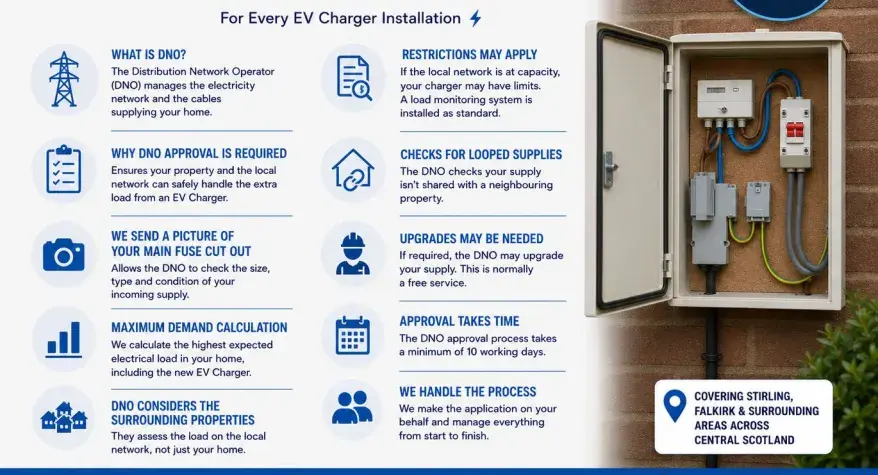
Many people assume fitting an EV charger is simply a case of connecting it to the electrical installation. However, every installation must be assessed to ensure both the property’s electrical installation and the local electricity network can safely support the additional load.
This is where DNO approval becomes essential.
What Is a DNO?
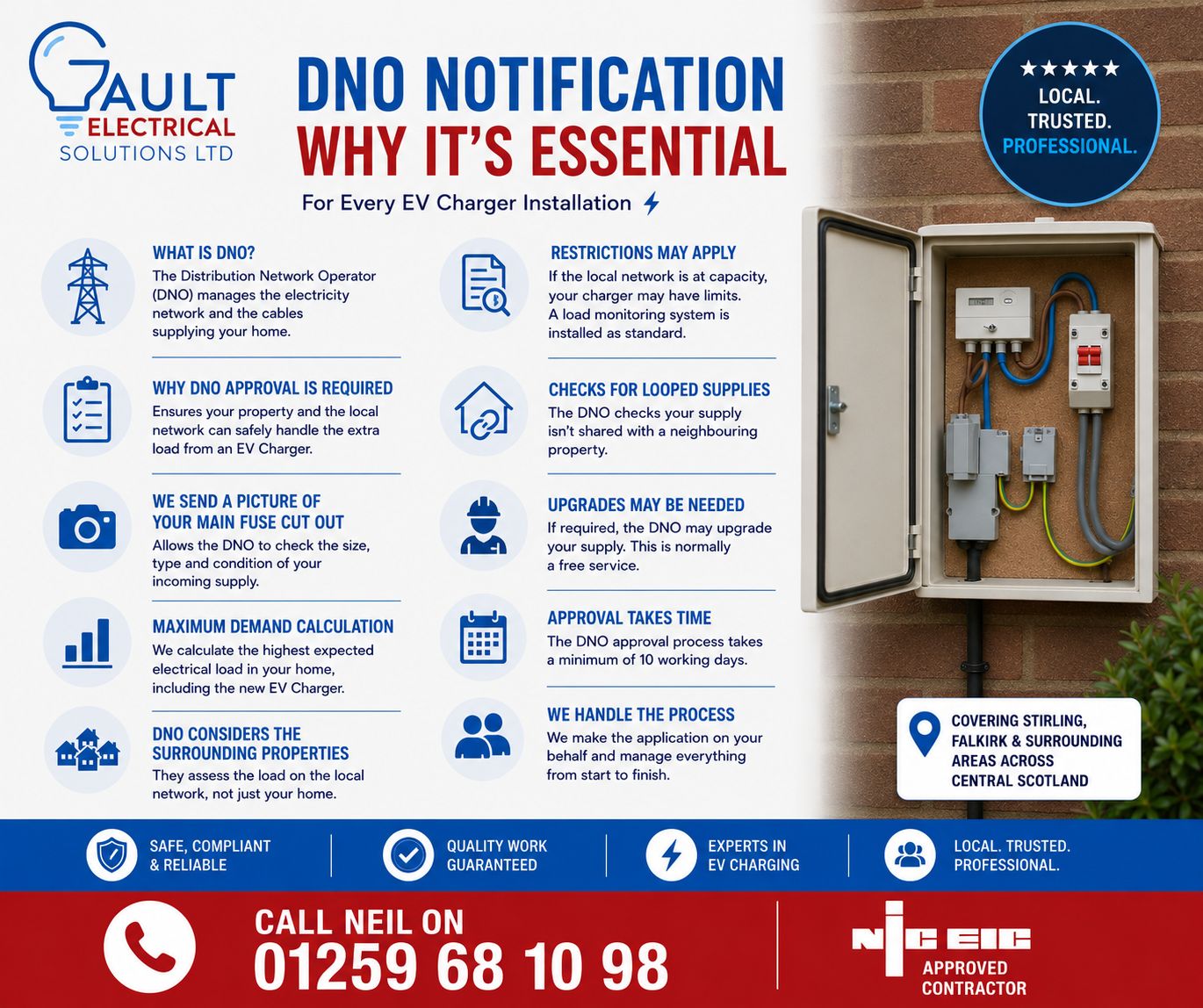
The Distribution Network Operator (DNO) is the company responsible for the electricity network that supplies your property.
Although you receive an electricity bill from your energy supplier, they are not responsible for the cables supplying your home.
The DNO owns and maintains:
- The underground and overhead electricity network
- The service cable supplying your property
- The main service fuse (cut-out)
- The capacity of the local electricity network
Their responsibility is ensuring the network can safely supply every property connected to it.
Why Is DNO Approval Required?
An EV charger can add a significant electrical load to your property.
A standard 7kW charger can draw around 32 amps continuously while charging your vehicle. Unlike many household appliances that cycle on and off, an EV charger can operate at full load for several hours.
Before this additional demand is connected, the DNO needs to confirm that both your property’s electrical supply and the local electricity network can safely accommodate it.4
This protects:
- Your property
- Your neighbours
- The local electricity network
- Future reliability of the supply
We Handle the Entire Application on Your Behalf
One of the biggest advantages for our customers is that we complete the entire DNO application process.
There is no complicated paperwork for you to complete.
As part of the application we gather the required information, prepare the technical calculations and submit everything for DNO approval.
Throughout the process we keep you updated until approval has been received.
What Information Do We Need From You?
The information we require from you is minimal.
The main item is your MPAN number.
What Is an MPAN?
MPAN stands for Meter Point Administration Number.
It is the unique reference number assigned to your electricity supply and allows the DNO to identify exactly which property is being assessed.
You’ll normally find your MPAN on your electricity bill, often in a box labelled “Supply Number”.
Once we have this number, we can begin preparing the application.
We Photograph Your Main Service Fuse
As part of every application, we take a photograph of your property’s main service cut-out and fuse.
This helps the DNO to verify:
- The size of your incoming supply fuse
- The type of service equipment installed
- The condition of the supply equipment
- Whether any upgrades may be required
This simple photograph provides important information before installation begins.
Calculating the Maximum Demand of Your Property
Another essential part of the application is calculating the maximum demand of your home’s electrical installation.
Maximum demand is an engineering calculation used to estimate the highest amount of electrical current your property could reasonably draw under normal use.
This calculation considers the electrical equipment installed within the property, such as:
- Electric showers
- Cookers
- Heat Pumps
- Storage heaters
- Immersion heaters
- Air conditioning
- Existing EV chargers
- General socket circuits
- Lighting
- Other fixed electrical equipment
We then include the proposed EV charger within these calculations.
This gives the DNO a realistic understanding of how much current the property could require and helps determine whether the existing supply is suitable.
The DNO Also Looks Beyond Your Property
One point many homeowners are unaware of is that the DNO doesn’t only assess your home.
They also consider the overall loading on the local electricity network.
Even if your home’s electrical installation is perfectly capable of supporting an EV charger, there may already be significant demand from surrounding properties connected to the same section of the network.
The DNO uses this information to ensure the local infrastructure continues to operate safely and reliably for everyone.
Why Some Chargers Have Charging Restrictions
Occasionally, the DNO may place restrictions on the maximum charging current permitted.
This doesn’t necessarily mean there’s a problem with your property’s electrical installation.
Instead, it’s often because the local network has limited spare capacity at that time.
In these situations, a load monitoring system is required.
This intelligent system continually monitors your property’s electrical demand and automatically adjusts the EV charger’s output when necessary.
When there is spare electrical capacity available, the charger operates normally.
If household demand increases, the charger temporarily reduces its output to ensure the property’s maximum permitted load is never exceeded.
We install load monitoring as a standard part of our EV charger installations, ensuring your charger operates safely while complying with DNO requirements.
Checking for Looped Supplies
The application process also checks whether your property has what’s known as a looped supply.
A looped supply is where two neighbouring properties share part of the incoming electricity service cable before it divides into each individual property.
While this arrangement has been used on many older housing developments, it isn’t always suitable for the increased demand created by modern EV charging.
If a looped supply is identified, the DNO will advise whether any work is required before the charger can be installed safely.
Sometimes Network Upgrades Are Required
Following their assessment, the DNO may decide that upgrades are needed before the EV charger can be connected.
Examples include:
- Upgrading the main service fuse
- Replacing older service equipment
- Separating a looped supply
- Reinforcing the local network
The good news is that these upgrades are normally carried out by the DNO at no cost to the homeowner, although each case is assessed individually.
These improvements help ensure the electricity supply is suitable not only for today’s requirements but also for future electrical demand.
How Long Does DNO Approval Take?
Customers are often surprised to learn that the approval process takes time.
In most cases, DNO approval takes a minimum of 10 working days, although more complex applications can take longer if additional investigations or network upgrades are required.
For this reason, it’s always advisable to begin the application process as early as possible when planning an EV charger installation.
Expert Guidance Every Step of the Way
Installing an EV charger involves much more than simply fitting equipment to a wall.
Behind every safe installation is a detailed engineering assessment that considers your property’s electrical installation, the local electricity network and future demand.
By handling the DNO application, calculating maximum demand, assessing the incoming supply, providing the required technical information and managing communication with the DNO throughout the approval process, we ensure every installation is completed correctly from the very beginning.
Understanding these requirements helps homeowners appreciate why the approval stage is such an important part of the installation process. It isn’t unnecessary paperwork—it’s there to protect your property, your neighbours and the wider electricity network, ensuring your EV charger can be used safely and reliably for many years to come.
Get in touch with Gault Electrical Today!